

Car Insurance Ontario High Risk (2026): Complete Guide to Affordable Coverage, Costs & Insurance Options
Introduction On Car Insurance Ontario High Risk
If you’ve been told you’re a high-risk driver in Ontario, finding affordable car insurance can feel frustrating. Many drivers are surprised when premiums increase after an at-fault accident, traffic conviction, licence suspension, or a gap in insurance coverage. Others struggle because several insurers decline to offer a policy at all.
The good news is that being classified as a high-risk driver does not mean you are permanently uninsurable. Ontario has a regulated auto insurance market, and drivers still have options through insurers that specialize in higher-risk policies and, when necessary, through the Facility Association.
This guide explains:
- What high-risk car insurance means in Ontario.
- Why insurers classify some drivers as high risk.
- Which factors increase insurance premiums.
- How much high-risk insurance typically costs.
- Which insurers may offer coverage.
- Practical ways to reduce your insurance costs over time.
- How to return to the standard insurance market.
Unlike many generic insurance articles, this guide focuses specifically on Ontario’s auto insurance system and uses information based on official regulatory guidance and industry practices.
Editor’s Note: Insurance premiums vary based on your driving history, vehicle, location, age, and the underwriting rules of each insurer. This guide is for educational purposes and should not replace a personalized insurance quote.
What Is High-Risk Car Insurance in Ontario?
High-risk car insurance is designed for drivers who insurance companies believe are more likely to file future claims than the average driver.
Being considered high risk does not automatically mean you are a dangerous driver. Instead, insurers evaluate different risk factors when calculating premiums. Drivers with previous accidents, serious traffic convictions, repeated violations, cancelled policies, or long gaps in insurance history may be placed in the high-risk category.
Unlike standard auto insurance, high-risk policies generally:
- Cost significantly more than standard policies.
- Offer fewer insurer choices.
- Require stricter underwriting.
- May include higher deductibles.
- Often require working with brokers who specialize in non-standard insurance.
Ontario insurers assess every application individually. Two drivers with similar driving records may still receive different premiums because insurers use different underwriting models.
Read More: High Risk Auto Insurance
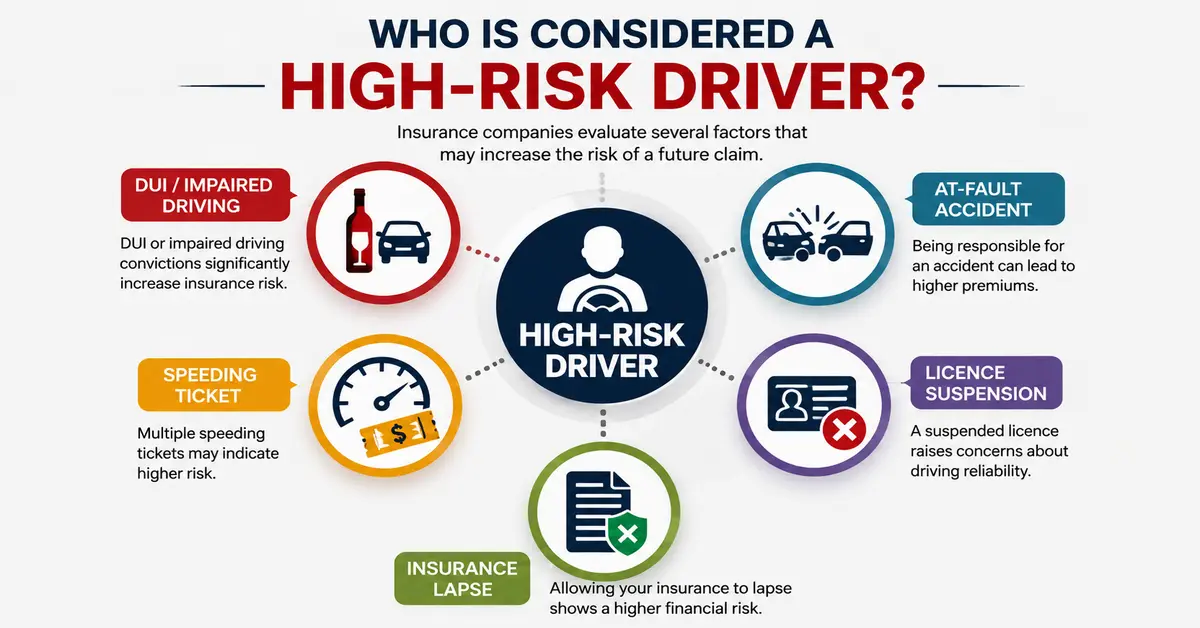
Who Is Considered a High-Risk Driver in Ontario?
There is no single government definition of a high-risk driver. Instead, each insurance company evaluates applicants using its own underwriting guidelines while operating within Ontario’s regulatory framework.
Drivers are commonly considered high risk because of one or more of the following reasons.
Multiple At-Fault Accidents
Drivers involved in several at-fault accidents within a relatively short period are generally viewed as presenting a higher future claims risk.
Insurance companies often consider:
- Number of at-fault accidents.
- Severity of each claim.
- Time since the accident.
- Total claims history.
One accident does not automatically place every driver into the high-risk market, but multiple accidents can significantly reduce available insurance options.
Serious Traffic Convictions
Major driving offences usually have a much greater impact on insurance premiums than minor infractions.
Examples include:
- Impaired driving (DUI).
- Careless driving.
- Dangerous driving.
- Racing or stunt driving.
- Criminal driving offences.
These convictions may affect insurance eligibility for several years depending on the offence and insurer guidelines.
Multiple Minor Convictions
While a single speeding ticket may not dramatically affect your premium, repeated violations can increase your risk profile.
Examples include:
- Speeding tickets.
- Failure to stop.
- Improper lane changes.
- Distracted driving offences.
- Disobeying traffic signs.
Insurance companies often evaluate both the number and frequency of convictions rather than looking at each ticket in isolation.
Licence Suspension
A suspended licence may indicate a higher level of risk from an underwriting perspective.
Reasons can include:
- Excessive demerit points.
- Serious traffic offences.
- Administrative suspensions.
- Impaired driving convictions.
After reinstatement, some drivers may find that fewer insurers are willing to provide standard coverage.
Insurance Coverage Lapse
Many drivers underestimate the importance of maintaining continuous insurance coverage.
Long gaps without insurance may raise questions for insurers, especially when no reasonable explanation is provided.
Examples include:
- Policy cancellation because of missed payments.
- Voluntary cancellation followed by an extended uninsured period.
- Driving without valid insurance.
Maintaining continuous coverage often improves eligibility with more insurers over time.
New Drivers With Poor Driving Records
Newly licensed drivers generally pay higher premiums because they have limited driving experience.
If a new driver also receives traffic convictions or causes at-fault accidents early in their driving history, insurers may classify them as high risk sooner than experienced drivers.
Quick Summary: Common High-Risk Factors
| Risk Factor | May Increase Premium? | May Reduce Insurer Options? |
|---|---|---|
| Multiple at-fault accidents | ✔ Yes | ✔ Yes |
| DUI or impaired driving | ✔ Significant | ✔ Significant |
| Careless driving | ✔ Yes | ✔ Yes |
| Licence suspension | ✔ Yes | ✔ Yes |
| Multiple speeding tickets | ✔ Yes | Sometimes |
| Insurance coverage lapse | ✔ Yes | Sometimes |
| New driver with several violations | ✔ Yes | ✔ Yes |
How Do Ontario Insurance Companies Determine If You’re a High-Risk Driver?
Many drivers believe a single speeding ticket automatically makes them a high-risk driver. In reality, Ontario insurance companies evaluate your overall risk profile, not just one incident.
Each insurer has its own underwriting guidelines, meaning one company may still offer you a standard policy while another considers you a high-risk driver.
When calculating your insurance premium, insurers generally look at several factors together rather than relying on one issue alone.
Driving Record
Your driving history is one of the most important factors.
Insurance companies typically review:
- At-fault accidents
- Traffic convictions
- Serious driving offences
- Licence suspensions
- Previous insurance claims
- Years of driving experience
Generally, a clean driving history over several years may help improve your insurance options.
Claims History
Insurance companies also review how often you’ve filed claims.
They may consider:
- Number of claims
- Type of claims
- Cost of previous claims
- Whether accidents were at fault
Drivers with repeated claims are often viewed as presenting a greater financial risk.
Insurance History
Your insurance history matters almost as much as your driving record.
Insurers may review whether you have:
- Maintained continuous coverage
- Missed premium payments
- Experienced policy cancellations
- Had long periods without insurance
Continuous insurance coverage often demonstrates lower underwriting risk.
Vehicle Type
The vehicle you drive can significantly affect your premium.
Examples of vehicles that generally cost more to insure include:
- Sports cars
- Luxury vehicles
- High-performance SUVs
- Frequently stolen vehicles
Vehicles with strong safety ratings and lower repair costs often qualify for lower premiums.
Location
Where you live also affects insurance pricing.
Insurance companies may evaluate:
- Accident frequency
- Vehicle theft rates
- Population density
- Traffic congestion
- Repair costs in your area
Drivers living in larger urban areas may pay higher premiums than drivers in lower-risk regions.
Driver Profile
Other rating factors may include:
- Driving experience
- Licence class
- Annual kilometres driven
- Vehicle usage (personal or business)
- Additional listed drivers
Every insurer weighs these factors differently.
Expert Insight
Two Ontario drivers with similar driving records can receive different insurance quotes because insurers use different underwriting models, pricing formulas, and eligibility requirements. Comparing multiple quotes is often one of the most effective ways to reduce costs.
Key Takeaway
High-risk classification is based on your overall insurance profile, not just a single ticket or accident.
How Much Does High-Risk Car Insurance Cost in Ontario?
There is no fixed premium for high-risk insurance in Ontario.
The amount you pay depends on several factors, including your driving history, vehicle, location, coverage limits, deductible, and the insurer’s underwriting rules.
Rather than focusing on an average number, it is more useful to understand which situations typically increase premiums the most.
Factors That Can Increase Your Premium
| Situation | Potential Impact on Premium |
|---|---|
| Multiple at-fault accidents | Very High |
| Impaired driving conviction | Very High |
| Careless or dangerous driving | Very High |
| Licence suspension | High |
| Multiple speeding convictions | Moderate to High |
| Insurance coverage lapse | Moderate |
| New driver with convictions | High |
Important: Premium increases vary by insurer. The exact cost depends on your personal circumstances and the insurer’s underwriting policies.
Why Do Quotes Vary So Much?
Many drivers are surprised when one insurer quotes significantly more than another.
This happens because insurers evaluate risk differently.
Some companies specialize in standard-risk drivers, while others have experience offering policies to drivers with more complex insurance histories.
That is why obtaining quotes from multiple insurers or working with an experienced insurance broker may help you identify more competitive pricing.
Quick Answer
Can high-risk drivers still find affordable insurance in Ontario?
Yes. Although premiums are generally higher, many drivers can still reduce costs by comparing quotes, maintaining a clean driving record, increasing deductibles where appropriate, and improving their insurance history over time.
Standard Insurance vs High-Risk Insurance
Understanding the differences between standard and high-risk insurance helps explain why premiums vary.
| Standard Insurance | High-Risk Insurance |
|---|---|
| Lower premiums | Higher premiums |
| More insurer choices | Fewer insurer choices |
| Easier approval | Stricter underwriting |
| Better discount opportunities | Limited discounts |
| Standard eligibility | Higher underwriting risk |
Being placed in the high-risk market does not mean you will remain there permanently.
Many drivers successfully return to standard insurance after maintaining a clean driving record.
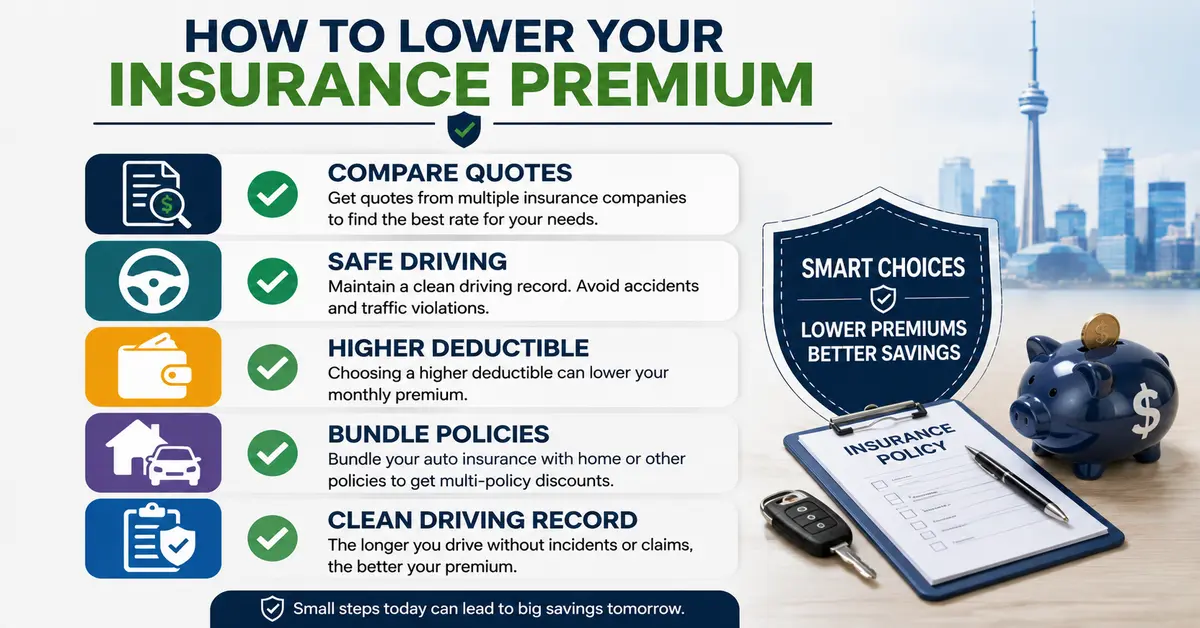
What Factors Can Help Lower Your Insurance Premium?
Although you cannot erase past driving history immediately, there are practical steps that may improve your insurance profile over time.
Maintain a Clean Driving Record
Avoid additional traffic convictions and at-fault accidents whenever possible.
Every year of safe driving may improve your future insurance options.
Compare Quotes Regularly
Insurance companies update their underwriting guidelines regularly.
A company that declined your application today may offer a competitive quote after your driving record improves.
Consider a Higher Deductible
Choosing a higher deductible may reduce your premium if it fits your financial situation.
However, make sure you can comfortably afford the deductible if you need to file a claim.
Bundle Eligible Policies
If available, combining home and auto insurance with the same insurer may qualify you for multi-policy discounts.
Choose a Lower-Risk Vehicle
Vehicles with lower repair costs, strong safety ratings, and lower theft rates may qualify for lower insurance premiums.
Keep Continuous Insurance Coverage
Avoid unnecessary gaps in coverage whenever possible.
Continuous insurance history often strengthens future insurance applications.
Expert Insight
Many drivers focus only on finding the cheapest premium. However, comparing coverage limits, deductibles, optional endorsements, claims service, and insurer reputation is equally important when choosing an auto insurance policy.
Key Takeaway
Reducing high-risk insurance costs usually takes time.
The combination of safe driving, continuous insurance coverage, and regular quote comparisons often provides the greatest long-term savings.
Best Insurance Companies for High-Risk Drivers in Ontario
Finding affordable high-risk car insurance is often less about finding a single “best” company and more about finding an insurer that matches your driving history and insurance needs.
Not every insurer accepts the same level of risk. Some focus primarily on standard drivers, while others have specialized underwriting programs for drivers with accidents, convictions, licence suspensions, or previous policy cancellations.
Working with an insurance broker can often increase the number of insurers available for comparison because brokers may have access to multiple insurance markets.
Quick Answer
There is no single best insurance company for every high-risk driver. The most suitable insurer depends on your driving history, location, vehicle, coverage needs, and the insurer’s underwriting guidelines.
Read More: Insurance Companies That Accept High-Risk Drivers
Insurance Providers Commonly Associated with High-Risk Drivers
| Provider | Best For | Notes |
|---|---|---|
| Facility Association | Drivers unable to obtain coverage elsewhere | Insurer of last resort |
| Jevco | Non-standard auto insurance | Available through brokers |
| Pafco | Drivers with multiple risk factors | Broker-distributed products |
| Coachman | Higher-risk drivers | Specialized underwriting |
| Echelon | Various higher-risk situations | Coverage availability depends on eligibility |
Important: Eligibility, premiums, and underwriting rules vary between insurers. A quote from one insurer should never be assumed to represent the entire market.
Expert Insight
Many drivers stop shopping after receiving one expensive quote.
That is often a mistake.
Different insurers evaluate risk differently. Even when two companies review the same driving record, the final premium may vary because each insurer uses its own underwriting model and pricing strategy.
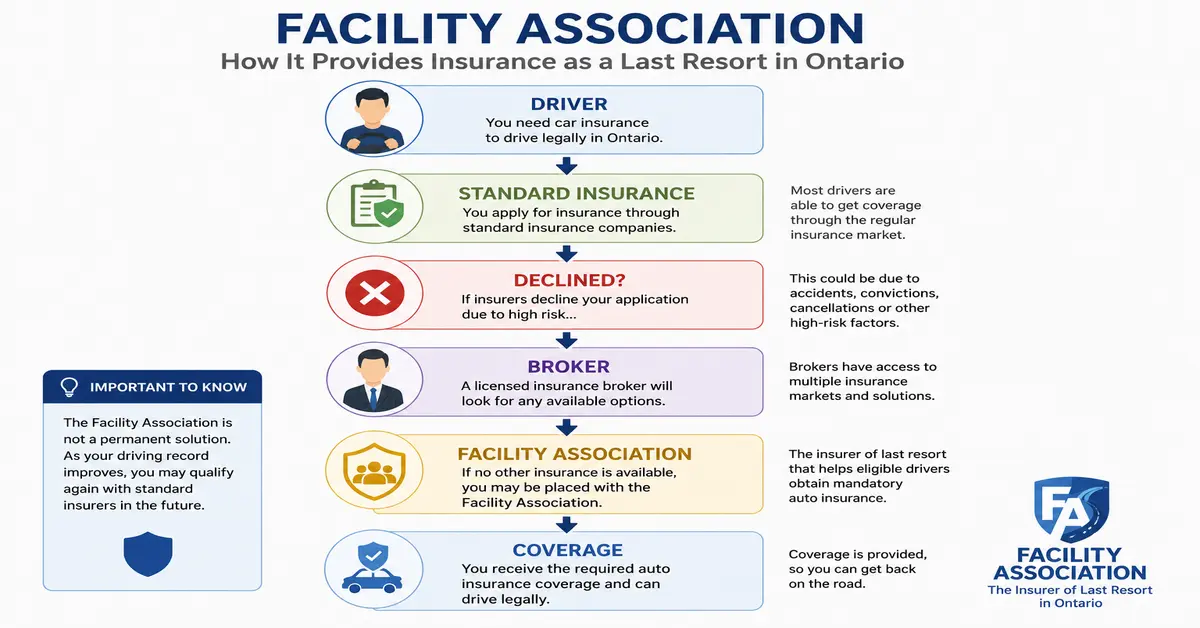
What Is the Facility Association?
Many Ontario drivers hear about the Facility Association only after being declined by several insurance companies.
The Facility Association is not an insurance company in the traditional sense.
Instead, it is an industry-supported organization that helps eligible drivers obtain mandatory automobile insurance when they cannot find coverage through the standard insurance market.
It serves as the insurer of last resort for eligible high-risk drivers.
Who May Need the Facility Association?
Drivers may be referred to the Facility Association when they have experienced situations such as:
- Multiple serious traffic convictions
- Several at-fault accidents
- Impaired driving convictions
- Repeated insurance policy cancellations
- Extremely limited insurance options in the voluntary market
Being placed through the Facility Association usually means insurance premiums are significantly higher than standard market rates because the insured driver represents a higher underwriting risk.
Can You Leave the Facility Association Later?
Yes.
Most drivers do not remain with the Facility Association permanently.
As your driving record improves and risk factors become less significant over time, you may again qualify for coverage with insurers operating in the standard insurance market.
Maintaining a clean driving record is usually the most important step toward returning to standard insurance.
Key Takeaway
The Facility Association is designed as a safety net—not a permanent insurance solution. Many drivers eventually transition back to standard insurers after improving their insurance profile.
How Long Will You Be Considered a High-Risk Driver?
One of the most common questions drivers ask is:
“When will my insurance go back to normal?”
The answer depends on several factors.
Insurance companies generally consider:
- Type of conviction
- Number of convictions
- Number of at-fault accidents
- Time since the incident
- Recent driving behaviour
- Overall claims history
There is no universal timeline that applies to every insurer.
Each company evaluates risk differently.
However, drivers who maintain several years of safe driving without additional violations generally improve their chances of qualifying for standard insurance again.
Read More: Insurance for High-Risk Drivers
What Can Slow Down Your Return to Standard Insurance?
Examples include:
- New traffic convictions
- Additional at-fault accidents
- Driving without insurance
- Policy cancellations due to missed payments
- Misrepresentation during insurance applications
Even one new incident may delay your progress toward lower insurance premiums.
Common Mistakes That Keep Drivers Paying High Premiums
Many drivers unintentionally increase their insurance costs by making avoidable mistakes.
Accepting the First Quote
Some drivers assume every insurer charges similar premiums.
This is not always true.
Comparing multiple quotes remains one of the simplest ways to identify more competitive pricing.
Choosing Price Over Coverage
The cheapest premium is not always the best value.
Review:
- Liability limits
- Deductibles
- Optional coverages
- Claims service
- Policy exclusions
before purchasing any policy.
Allowing Insurance Coverage to Lapse
Long gaps without insurance may make it harder to qualify for better premiums later.
Whenever possible, maintain continuous insurance coverage.
Failing to Review Your Policy
Your circumstances may change over time.
Review your policy annually to determine whether:
- Coverage limits remain appropriate.
- Discounts have become available.
- Another insurer offers better value.
Expert Insight
Many high-risk drivers focus only on today’s premium.
Experienced brokers often focus on building a path back to the standard insurance market, which can reduce insurance costs over the long term.
Buying Checklist Before Choosing a High-Risk Insurance Policy
✔ Compare quotes from several insurers or brokers.
✔ Review liability limits carefully.
✔ Understand your deductible.
✔ Ask about available discounts.
✔ Confirm optional coverages.
✔ Read policy exclusions.
✔ Maintain continuous insurance coverage.
✔ Drive safely to improve future eligibility.
Should You Work With an Insurance Broker?
If you’re finding it difficult to get approved for car insurance or you’re receiving expensive quotes, working with a licensed insurance broker may be worth considering.
Unlike insurers that offer only their own products, many brokers can compare policies from multiple insurance providers based on your eligibility.
For high-risk drivers, this may increase the chances of finding suitable coverage without contacting insurers individually.
However, not every broker works with the same insurance companies, so comparing broker options can also be beneficial.
When a Broker May Be Helpful
A broker may be useful if you:
- Have been declined by one or more insurers.
- Have multiple at-fault accidents.
- Have a serious driving conviction.
- Recently had your licence reinstated.
- Need help understanding different policy options.
- Want to compare quotes from several insurers.
Expert Tip: Ask the broker which insurers they represent. Some brokers have access to a wider range of non-standard insurance providers than others.
Optional Coverages to Consider
Every driver has different insurance needs.
Beyond Ontario’s mandatory coverages, many insurers offer optional coverages that may provide additional financial protection.
Common optional coverages include:
Collision Coverage
Helps pay for damage to your vehicle after a collision, regardless of fault, subject to your deductible and policy terms.
Comprehensive Coverage
May help cover damage caused by events other than collisions, such as theft, vandalism, fire, hail, or falling objects.
Specified Perils Coverage
Provides protection against specific risks listed in your policy rather than all risks covered under comprehensive insurance.
Loss of Use Coverage
May help pay for temporary transportation expenses while your insured vehicle is being repaired after a covered claim.
Accident Forgiveness
Some insurers may offer accident forgiveness endorsements for eligible drivers. Availability, eligibility requirements, and conditions vary by insurer.
Key Takeaway
Optional coverages can improve financial protection, but they also increase premiums. Review your needs carefully before adding endorsements to your policy.
Read More: High Risk Drivers Insurance
Frequently Asked Questions On Car Insurance Ontario High Risk
Is high-risk car insurance mandatory?
No.
High-risk insurance itself is not mandatory. However, every vehicle driven on public roads in Ontario must have legally required automobile insurance.
Can I switch insurance companies while I’m considered high risk?
Yes.
If another insurer is willing to offer coverage, you may switch policies. Always compare coverage, deductibles, and policy terms—not just the premium.
Does one speeding ticket make me a high-risk driver?
Not necessarily.
Insurance companies assess your overall driving record and underwriting risk rather than relying on a single minor conviction.
Can I reduce my premium after one year?
Possibly.
Some drivers may receive better quotes after maintaining a clean driving record, but the timeline varies by insurer and individual circumstances.
What happens if no insurer accepts my application?
Eligible drivers who cannot obtain insurance through the standard market may be able to obtain coverage through the Facility Association.
Does my postal code affect insurance premiums?
Yes.
Location is one of several factors insurers may consider when calculating premiums.
Should I choose the cheapest policy?
Not always.
Review liability limits, deductibles, optional coverages, exclusions, and claims service—not just the monthly premium.
Can I return to standard insurance?
Yes.
Many drivers eventually return to the standard insurance market after maintaining a clean driving record and improving their insurance profile over time.
Does a lapse in insurance coverage matter?
It can.
Long gaps in insurance coverage may affect underwriting decisions and future premiums depending on the insurer.
Is every insurer’s definition of “high risk” the same?
No.
Each insurer uses its own underwriting guidelines, which means eligibility and premiums can differ even for drivers with similar records.
Conclusion On Car Insurance Ontario High Risk
Being classified as a high-risk driver in Ontario does not mean you have no insurance options.
While premiums are generally higher than standard auto insurance, many drivers successfully reduce their insurance costs over time by maintaining a clean driving record, comparing quotes regularly, and reviewing their coverage needs as their circumstances change.
Understanding how Ontario insurers evaluate risk—and making informed insurance decisions—can help you move back toward the standard insurance market when your eligibility improves.
Rather than accepting the first quote you receive, take time to compare insurers, understand your policy, and choose coverage that fits both your budget and your long-term needs.
Official References
Ontario Insurance System
Ontario’s auto insurance industry is regulated by the Financial Services Regulatory Authority of Ontario (FSRA), which oversees insurance regulation, consumer protection, and rate oversight in the province.
Facility Association
Drivers who cannot obtain insurance through the standard market may be eligible for coverage through the Facility Association, which serves as Ontario’s insurer of last resort.
Section: Insurance Basics
The Insurance Bureau of Canada (IBC) provides consumer information about auto insurance, claims, fraud prevention, and insurance terminology.
Section: Driver Licensing
Driver licensing requirements and official driving regulations are available through the Ontario Ministry of Transportation.



